
Hollywood Lies

I was raised to be very skeptical of the media, salespeople and politicians.
Long before I was born my father was a professional con man. Among other things he was what is called a mechanic. He would be hired to deal a private poker game and then stack the deck in order to extract as much money as he could from a ‘mark’, or target. He claimed to have done this in the employ of the mafia but he was also an exceptional liar, so who knows. But on many occasions I saw him do things with playing cards that I can’t explain to this day, so it’s not unbelievable.
I think this is why he hated television commercials with a passion. He could see right through the psychological techniques they used to manipulate audiences and it enraged him. Back then the closest thing to a remote control was one of us kids, and we learned quickly about the importance of turning down the volume before the first word of a commercial came through the speaker. I’m sure I’m better off for it.
So when I was twenty years old and saw the documentary film Manufacturing Consent, which is about Noam Chomsky and Edward Hermann’s book of the same name, I was already primed to accept the main thesis of their work. In fact it really just gave me a vocabulary and evidence for suspicions I already had about the media’s role in creating and perpetuating popular support for capitalism and imperialism. Unfortunately I wasn’t equipped to do anything with that information at that time1, so instead of radicalizing me further it just helped me rationalize my depoliticization.
It would be more than thirty years before I watched the film again, but this time it came as part of a deep dive into socialist political theory so I had a lot more use for the information and I was better equipped for the resulting depression. It has also been helpful inasmuch as it has provided support for an analytical framework for understanding the massive tide of propaganda we’ve been swimming against during Israel’s genocide in Gaza (now fully extending into Lebanon). I’m halfway through a book called The Complicit Lens, by Robin Andersen that illuminates this thoroughly.2
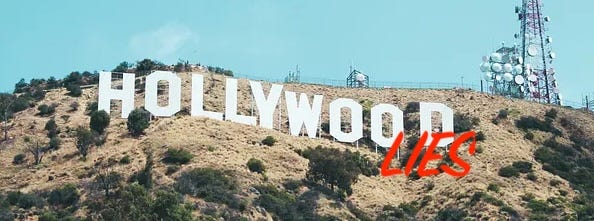
For all these very valid criticisms of the news media, something arguably more insidious and influential is how Hollywood packages and promotes U.S. propaganda around the whole world. A friend of mine from the global south recently told me how she had grown up admiring America, even knowing all the horrific things it had done in her part of the world. I have no doubt that Hollywood gets a lot of credit for that.
I’ve spent quite a few hours over the past week watching interviews with Samantha Youssef, in which she discusses Hollywood propaganda from her insiders perspective. It has been incredibly enlightening. I’ve also done a couple careful readings of her paper, Encoding Empire: How Black Panther Manufactures Consent for Imperialism Among Oppressed Groups, in which she does a “thematic analysis”3 of the Black Panther franchise to reveal the many ways it works as pro-empire propaganda.
Most critically, Samantha, who has Palestinian-Ukrainian heritage, has come out4 very strongly against the new film The Voice of Hind Rajab. This critique was actually the first time I engaged with Samantha, in a private chat group, and it took me by surprise. I had heard nothing but good things about the film until then, and largely from other Palestinians (including Hamza and Badie Ali, the founders of the film’s distribution company Watermelon Pictures).5
I admit I wasn’t planning to watch the film to begin with because I followed the story as it unfolded in realtime and I figured the film would just depress and anger me. Not only did Samantha’s analysis reinforce my choice, it made me want very much to discourage anyone else from seeing or promoting this film. I’m not going to try to reproduce her arguments here, you can read/listen to her yourself and come to your own conclusions. But for me the undeniable conclusion is that this film ultimately does more harm than good (if any) for the cause of Palestinian liberation.
This is the important point. I am a big supporter of Watermelon Pictures. I bought a hoodie before Watermelon+ launched and subscribed the day it did. I’ve also met Hamza and Badie and I have much respect for their work. So as uncomfortable as it is to say so, especially as someone who is not Palestinian and who wants very much for Hind’s story to be told, I think supporting and promoting this film is a mistake. Now when I see movement groups hosting screenings it makes me cringe.
Unfortunately the popularity of this film in the mainstream likely means irresistible economic incentives to continue promoting and supporting it, but maybe that is the silver lining? If the popularity of this film brings new money and customers to Watermelon+, maybe that elevates the better films they have, like Palestine 36.6
For some insight into why that is, see my previous post: About Me (sorry)
I’ll be interviewing the author when I’m done so stay tuned for that.
A very cool methodological approach I learned about from her paper.
Samantha shares an in-depth analysis with Dr. Jared Ball in this interview.
Yes, I write this cognizant of the fact that it might be read by all parties mentioned!
Thank you Tom.
I could not pull myself together to watch the film. It would depress me and distract from action.
I am now very intrigued to watch and read what Samantha Youssef has to say. We need to become better and better at critical thinking as uncomfortable as the process may be. So, reading eye-opening articles like yours or watching Youssef directly helps with that.
Thanks
Looking forward to the interview with Robin Anderson. I hadn't heard of her book but met her at the Izzy Awards in Ithaca and she told me about it. It's on my reading list.